MEF 2025: Just Green Transition for the Western Balkans
Announcements
Date 18 June 2025


MEF25 Highlights Momentum for a Just and People-Centered Energy Transition in the Western Balkans
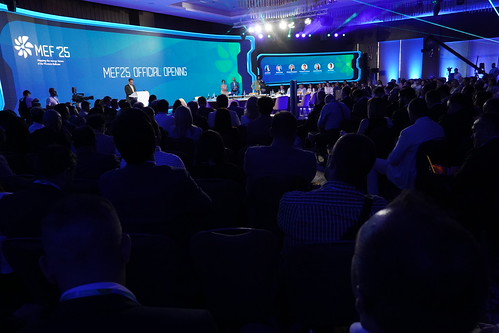
Skopje, June 18, 2025 – The Macedonian Energy Forum 2025 (MEF25), organized by ZIP Institute in Skopje with support from Open Society Foundations – Western Balkans, brought together political leaders, international institutions and civil society to advance a shared vision for a people-centered energy transition.
The forum highlighted growing momentum in the region with advances in clean energy laws, citizen-driven innovation and cross-border cooperation.
Agim Selami, executive director of the Macedonian Energy Forum, said energy was no longer a technical matter but a social, political and generational issue. Izet Mexhiti, North Macedonia’s first deputy prime minister and minister of environment and spatial planning, called for reduced coal dependence and an ecological, socially just transition.
North Macedonia’s minister of energy, Sanja Bozinovska, outlined a new energy law, a liberalized market and citizen-led energy communities, while Michalis Rokas, EU ambassador to North Macedonia, urged deeper regional cooperation. Francesco La Camera, director-general of the International Renewable Energy Agency (IRENA), warned that meeting global energy goals would require $1.3 trillion annually and said the Western Balkans must not be left behind.
Miodrag Milosavljevic, deputy director of Open Society Foundations – Western Balkans, said the transition must move beyond compliance to become a strategy for development, fairness and regional cohesion.
Panels also tackled the EU Clean Industrial Deal and the geopolitics of critical raw materials, emphasizing innovation, responsible governance and public-private collaboration to secure a climate-resilient and competitive Western Balkans.
Toward a Clean Industrial Future
A panel on aligning with the EU Clean Industrial Deal underscored the role of state-led industrial policy and public-private partnerships in shaping a competitive and climate-resilient Western Balkans.
Speakers including Besnik Vasolli of the Kosovo German Chamber of Commerce and Antje Wandelt of the German Industry Delegation stressed the need for innovation financing, vocational education and digital governance.
Branimir Jovanovic from the Vienna Institute for International Economic Studies warned against unchecked foreign control, emphasizing the importance of economic sovereignty and anti-corruption measures.
Olimpija Hristova Zaevska, CEO of Elson Solutions, called for public-private cooperation to unlock green industrial competitiveness, while Maja Pokrovac of Renewable Energy Sources of Croatia highlighted successful models in agro-solar development and energy storage.
Critical Raw Materials: A Geopolitical Challenge
Another panel focused on securing critical raw materials (CRMs) for the energy transition without compromising democracy, environmental standards or regional stability
Experts warned that Europe’s shift to clean energy requires a parallel mining transition. Speakers emphasized the importance of robust governance, social consensus and responsible mining practices. Rebecca Burton of the Initiative for Responsible Mining Assurance (IRMA) said: “The energy transition cannot happen without a mining transition.”
With the Western Balkans’ rich mining legacy and significant CRM reserves, the region could play a strategic role in Europe’s clean energy supply chain.
Sait Uysal, the founder of the Türkiye Critical Minerals Initiative urged governments and stakeholders in the region to systematically explore CRM recovery from secondary sources as a viable, cleaner alternative to new mining extraction. He argued thatWestern Balkans can play a pivotal role in CRM supply while contributing to environmental rehabilitation and local economic development.
As the region accelerates its energy transition, MEF25 underscored the need for transformative policies, innovation and strong governance to ensure the benefits of transition reach every community and citizen. The forum made clear that the region has the momentum and ambition to lead on clean energy, but success will depend on collaboration, accountability and people-centered solutions.
Learn more about OSF-WB’s work on Just Green Transition
Related News On This Thematic Area

The Questions Were Already There
An organization that has worked on environmental rights in Tuzla since 2001 convened a Summer School on artificial intelligence....

Small municipalities, big ambition: Western Balkans mayors move from declaration to action
Six years ago, Open Society Foundations Western Balkans put a simple idea on the table: solar panels on school...

PREPARATION OF PROJECT DOCUMENTATION AND INSTALLATON OF PHOTOVOLTAIC SOLAR POWER PLANTS CONNECTED TO THE ELECTRICAL POWER SYSTEM IN SIX (6) SCHOOLS – NORTH MACEDONIA
SUBJECT OF THE PROCUREMENT 6. Description of the procurement:The subject of the procurement is the preparation of project documentation...

